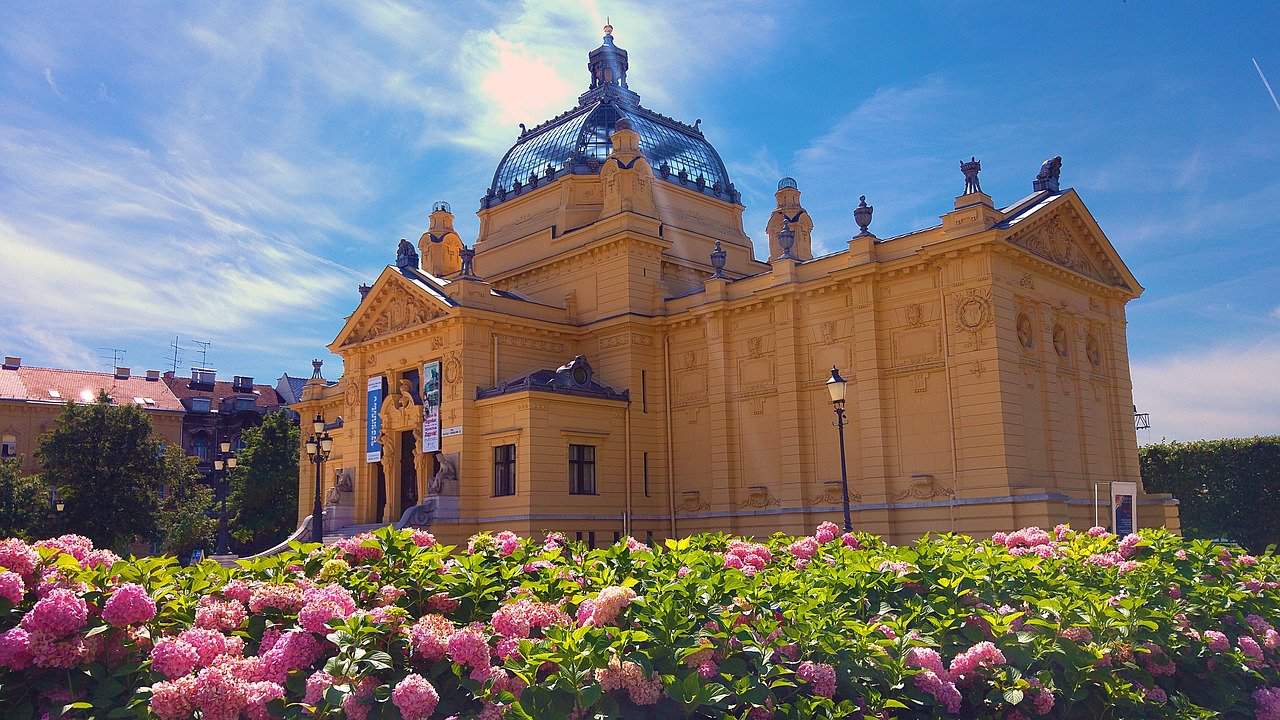
Croatia is a country of a millennial history, great geographic diversities and a rich cultural heritage. The territory of contemporary Croatia has been inhabited ever since the prehistoric times, and, among others, even the ancient Greeks and Romans left their marks in the coastal region.
Located in the southeast of Europe, Croatia unifies many differences, from the crystal blue Adriatic with a thousand island, mountainous landscape of Gorski kotar and Lika, to the vast Slavonian fields. Eight national parks, picturesque Mediterranean towns and cities still keeping the atmosphere of times long past, the metropolitan lights of Zagreb – these are only some of the well-known images of Croatia.
Just as Croatia is diverse geographically, so is its cuisine full of differences.
Slavonia is famous for spicy specialties such as ‘kulen’, ‘kolenova seka’, ‘čvarci’ and ‘fiš paprikaš’. Dalmatia offers lighter food. First and foremost, fish and other seafood. An important part of the diet is also prosciutto, dried on the harsh north-eastern wind ‘bura’. Different sausages, prosciutto hams and ‘kopsica’ are especially characteristic for the area of Dalmatinska zagora (Dalmatian inland).
Light cheese, cream, and ‘štrukli’ are trademarks of Hrvatsko zagorje, while the fragrant truffles, ‘fuži’ and ‘plukanci’ are popular in the Istrian peninsula.
Croatia also has a long tradition of grapevine growing, and the oldest trails lead as far as the times of antiquity. Just as it is diverse in gastronomy, the same can be said of Croatia when considering its wines. Thus, on the peninsula of Pelješac one will come across stronger and tart wine sorts such as ‘dingač’, ‘postup’ or ‘plavac’, while in Istria, Hrvatsko zagorje and Slavonia, wines are white and lighter, embodied perfectly in sorts such as Istrian ‘malvazija’ or ‘traminac’ of Ilok and the like.
A vital part of the culinary tradition in Croatia is definitely olive oil. Offering many different tastes and aromas, it is an unavoidable food additive in many a traditional meal.
Another reason to visit Croatia is surely its cultural festivals. For all you film lovers, we would recommend the Pula Film Festival taking place in the old Roman arena or the Motovun Festival, located in a tiny Istrian town on the top of a hill. Drama fans and classical music lovers will be more than pleased to be introduced to the Summer of Split and the Dubrovnik Summer Festival.